


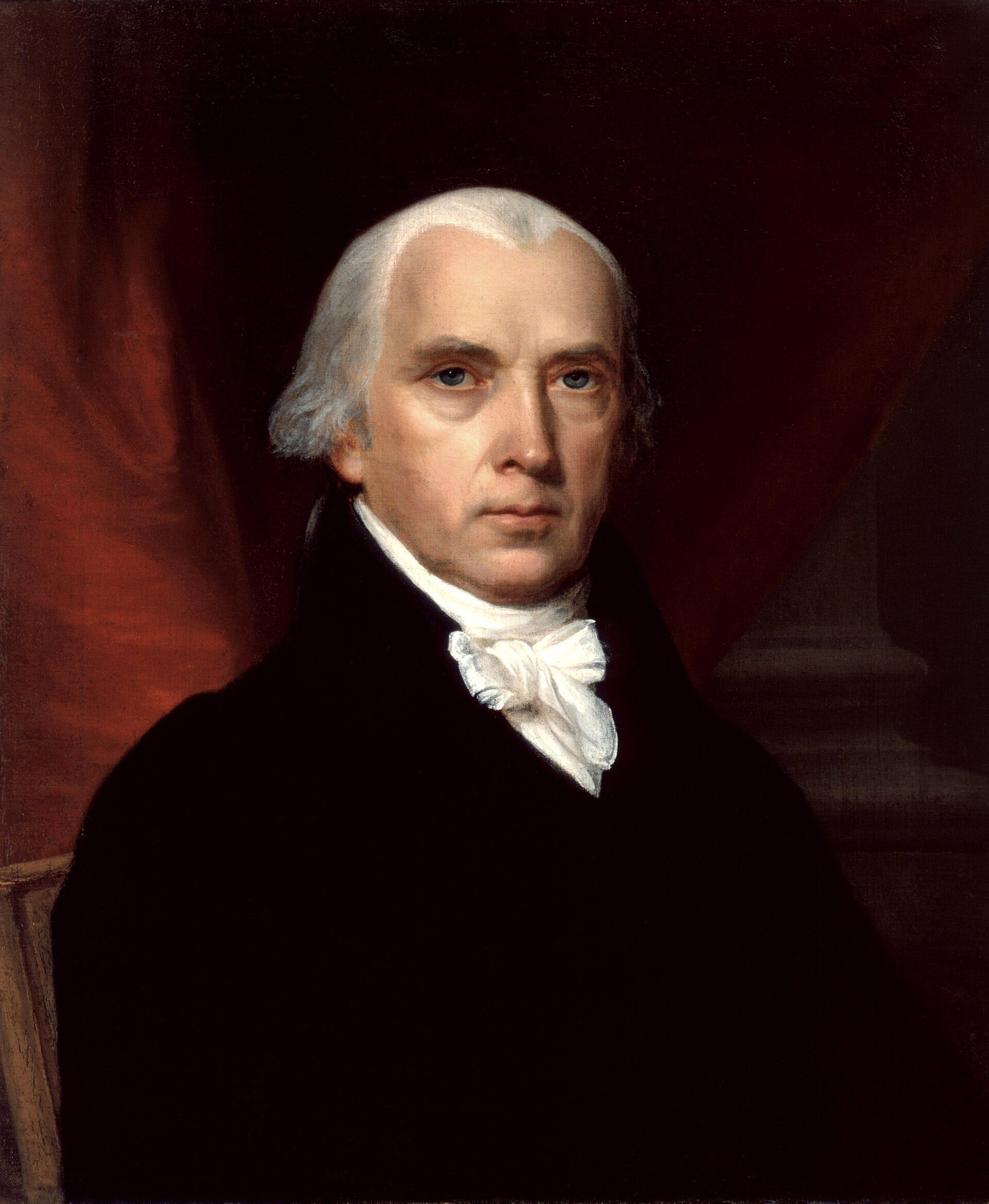
James Madison did not command a room. He didn’t have the physical presence of Washington, the rhetorical fire of Hamilton, or the philosophical grandeur of Jefferson. He was short, slight, soft-spoken, and by most accounts, a genuinely poor public speaker.
He was also the most consequential architect of American history.
Not an architect of buildings, but of systems. The Constitution, the Bill of Rights, the Federalist Papers, and the structure of the presidency itself all carry Madison’s fingerprints, but most Americans couldn’t tell you what he did (beyond being the fourth president).
Most Americans know much more about Washington, Hamilton, and Jefferson. That gap between contribution and recognition should feel familiar to every quiet leader reading this.
Madison’s path to the Constitutional Convention was not the one that gets dramatized. There was no stirring speech, no dramatic gesture, and no moment of visible heroism, but there was a mountain of preparation.
While other delegates were still debating whether to attend the Convention at all, Madison was doing the pre-meeting work. He had spent months studying every confederacy and republic in history: the Amphictyonic League, the Achaean League, the Swiss cantons, the Dutch republic, and more. Then, he cataloged the structural failures of the Articles of Confederation with the precision of an engineer performing a postmortem. He had mapped the weaknesses, identified the patterns, and arrived in Philadelphia with a framework already drafted.
His framework was called the Virginia Plan, and it became the foundation of every serious constitutional discussion that followed.
This is what quiet leaders do. They don’t arrive at the meeting to discover what the conversation will be about; they arrive having already shaped it. Madison didn’t need to dominate the room in Philadelphia because he had done the work that made the room’s best thinking possible. That was how he left his impact on this country.
But the loud voices at the Convention are the ones history remembers. Gouverneur Morris is remembered for speaking more than anyone. Hamilton gave a famous six-hour speech advocating for a system that was rejected almost entirely. Luther Martin talked so long that other delegates left the room.
Madison spoke comparatively little, but his ideas were so precisely constructed that they consistently redirected the conversation and ultimately influenced the final outcomes of the Convention that shaped our nation. He didn’t compete for airtime; he chose his moments deliberately, and each intervention shifted what happened next.
He made his mark not through force or volume, but through judgment applied at exactly the right moment.
Madison’s impact showed up not in how much space he took, but in how deliberately he used it.
He listened more than he debated, and while others were performing their positions for the room, Madison was taking detailed notes on every argument, every objection, and every shift in the Convention’s thinking. Those notes became the primary historical record of what happened there.
Leading up to the Convention, the Virginia Plan involved months of solitary intellectual work on Madison’s part, but it became the framework for the entire discussion. Without it, the delegates may have spent weeks arguing about process before they ever reached substance.
Another one of Madison’s quiet leader attributes is that he built coalitions through private conversation rather than public persuasion. He understood that the room’s decisions were actually shaped in the margins, not at the podium. This is the pre-meeting influence that quiet leaders are uniquely equipped to exercise because of our intense preparation: sharing our thinking with the right people, in the right setting, before the formal discussion begins.
Madison also let others carry the visible credit. The Constitution is not called “Madison’s Constitution” in popular culture, even though scholars consistently credit him as its primary architect. Washington presided over the Convention, Franklin provided the elder statesman’s blessing, and Hamilton championed ratification with the most visible public advocacy. But Madison did the structural work that made all of this possible, and he is the least remembered of all.
Despite Madison’s clear impact, I don’t mean to imply that he achieved all of this alone. The partnership between Madison and Hamilton during the ratification debate is perhaps the clearest historical example of the quiet side / loud side dynamic that I have talked about being so helpful in previous writing.
Together with John Jay, they wrote the Federalist Papers: 85 essays arguing for ratification of the Constitution. Hamilton wrote 51 of them. Madison wrote 29. Jay, slowed by illness, wrote 5.
Hamilton’s essays were passionate, forceful, and politically charged. They made the emotional case for a strong federal government with the kind of rhetorical energy that moved public opinion.
Madison’s essays were structural. Federalist No. 10, his argument about factions and the design of a republic large enough to contain them, is widely considered the single most important piece of political writing in American history. It didn’t persuade through passion; it persuaded through architectural reasoning so thorough that the counterarguments simply couldn’t find purchase.
Hamilton got more essays published, but Madison wrote the ones that made ratification a done deal.
This is the pattern every quiet leader will recognize. The loud partner produces volume while the quiet partner produces the thing that lasts. Both are necessary, but the world tends to remember the volume first and sometimes forgets the foundation entirely.
The evidence is here in pop culture: Hamilton now has a Broadway musical while Madison has a university in Virginia that most people don’t even associate with him. The asymmetry would be funny if it weren’t so precisely representative of how credit flows.
Though I am celebrating him now, Madison paid real costs for his quiet approach.
In an environment that rewarded oratory, his inability to project in a large room limited his direct political influence. He was not a campaigner, and he could not move a crowd the way Patrick Henry or Hamilton could. And though he became president, his presidency is generally considered unremarkable by historians, in part because the skills that made him the greatest political architect of his generation did not translate into the performative demands of the executive role.
This is the cost quiet leaders often bear: the skills that produce the most durable contributions are not the skills that produce the most visible careers. Madison’s framework has outlasted every speech Hamilton ever gave, but Hamilton’s career trajectory was faster, more dramatic, and more celebrated during their lifetimes.
The quiet leader’s bargain is accepting that the arc of impact and the arc of recognition operate on different timelines. Sometimes those timelines converge, but often they don’t. Madison lived long enough to see the Constitution endure, but he did not live in an era that would have called him its architect. That label came later, assigned by historians with the distance to see what contemporaries, dazzled by louder voices, could not.
I think about Madison when I watch quiet leaders struggle with the same tension he embodied.
The leader who builds the system and then watches the person who presents the results receive the recognition. Or the leader who does the pre-meeting work that shapes the decision and watches the loudest voice in the room get credited. Or the leader who writes the document that reframes the problem, only to watch someone else summarize it and own the conclusion.
These are not failures of the quiet leader’s approach. They are the structural cost of operating in systems that attribute ideas to whoever expressed them most visibly. Madison’s experience proves that this cost is not new. It is as old as organized human endeavor.
But Madison’s legacy also proves something else: the framework outlasts the speech. The system outlasts the personality. The architecture outlasts the applause.
Every speech Hamilton gave is a historical artifact, but the Constitution is a living document. That is not a coincidence. It is the difference between what performance produces and what intentional architecture produces. The former produces a moment, while the latter produces much more.
If Madison were operating in a modern business, he would be the person who arrives at the offsite having already mapped the strategic landscape. He would be the one who writes the document that reframes the quarterly debate before anyone else has articulated the question. He would build the systems, the processes, and the frameworks that everyone else operates on without thinking about who built them.
He would also be the one whose name doesn’t come up in succession conversations, all because the people making those decisions never saw his capability performed in a way they could easily recognize.
The question Madison’s story raises for quiet leaders is not whether your approach is effective. The historical record answers that definitively. The question is whether you can sustain the patience required to let your work prove itself, even when the room is applauding someone else.
That patience is not passive. It is the most active form of restraint there is: continuing to build the thing that matters while knowing the recognition may arrive late, arrive attributed to someone else, or never arrive at all.
Madison’s story matters for quiet leaders because it offers the rarest thing in the leadership conversation: proof at scale.
Most leadership philosophy operates on anecdotes—a story about a meeting, a team, a company. Madison’s story offers proof at the scale of a nation. The quietest person at the Constitutional Convention built the most durable political framework in modern history. His preparation outperformed every speech, his architecture outlasted every personality, and his influence, exercised through private conversation and structural thinking rather than public persuasion, shaped a document that has governed hundreds of millions of people across nearly two and a half centuries.
If quiet leadership can produce that, the question of whether it “works” is settled.
The remaining question, and it is one Madison himself could not have answered, is whether you will be recognized for what you build. History suggests that you may not be, but history also suggests that what you build will still be standing long after recognition ceases to matter.
Further Exploration
If this Quiet Icon resonated with you, here are places to explore Madison’s life, work, and leadership more deeply:
James Madison: A Life Reconsidered by Lynne Cheney: a biography that foregrounds Madison’s intellectual architecture rather than his political career
The Federalist Papers, particularly No. 10 and No. 51: Madison’s structural arguments in his own words
Plain, Honest Men by Richard Beeman: the story of the Constitutional Convention with attention to how the quieter delegates shaped the outcome


